Functional behavior
Authenticated loading, dashboard KPIs, brands, pipeline, tasks, command palette, theme switching, and accounting flows.
 OrbelithExplore the product
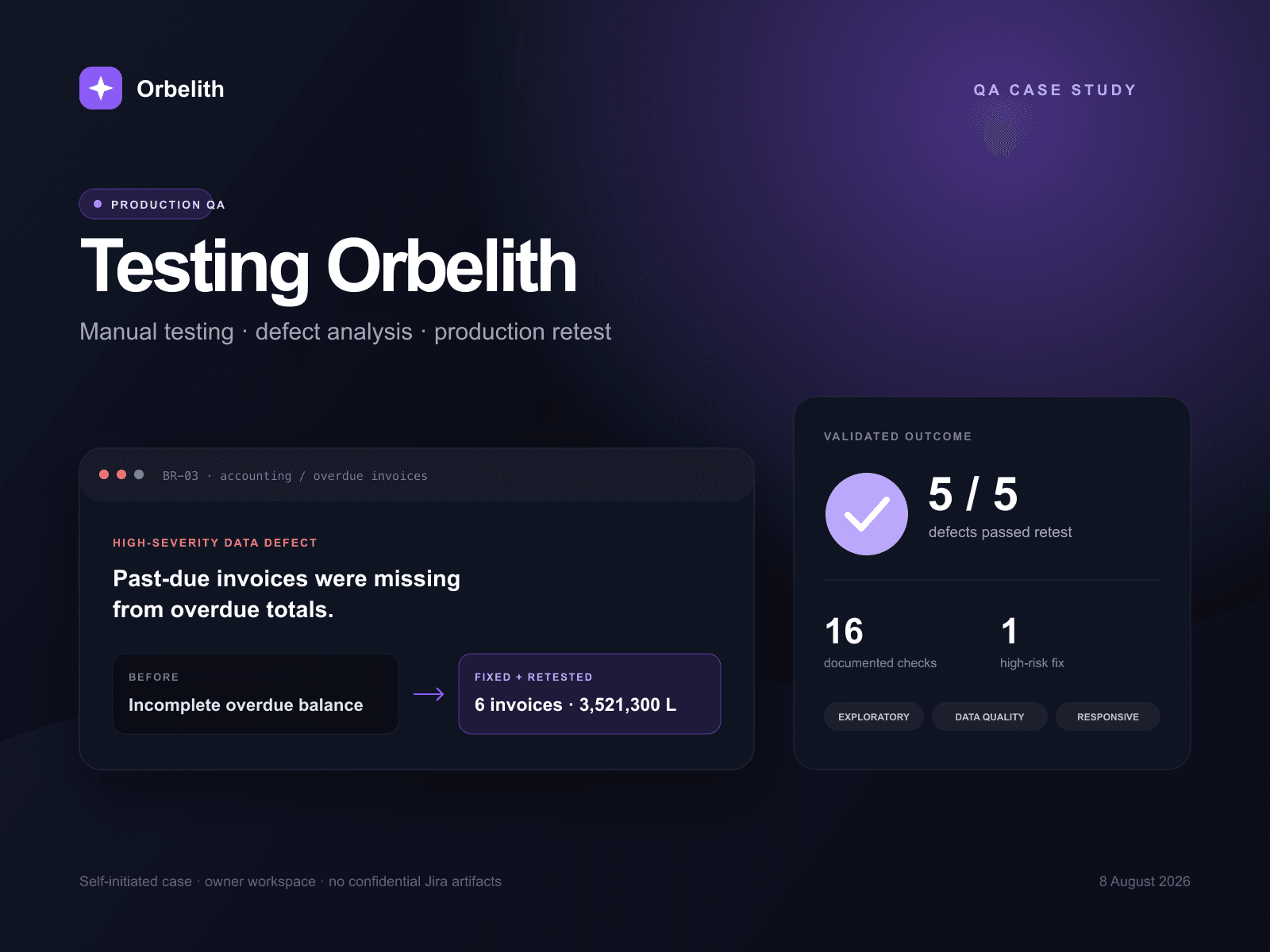
A focused production QA pass that turned functional, financial, localization, and data-consistency findings into verified fixes.
Test objective
The pass targeted authenticated workflows and the consistency of the data behind them. It used the live owner workspace with demo records and avoided destructive actions, payment execution, outbound messages, exports, and third-party credentials.
Authenticated loading, dashboard KPIs, brands, pipeline, tasks, command palette, theme switching, and accounting flows.
Cross-page comparison of task counts, invoice classification, overdue totals, and pipeline metrics against visible records.
Empty states, English and Russian localization, desktop and 390 px mobile behavior, plus unauthenticated API boundaries.
Approach
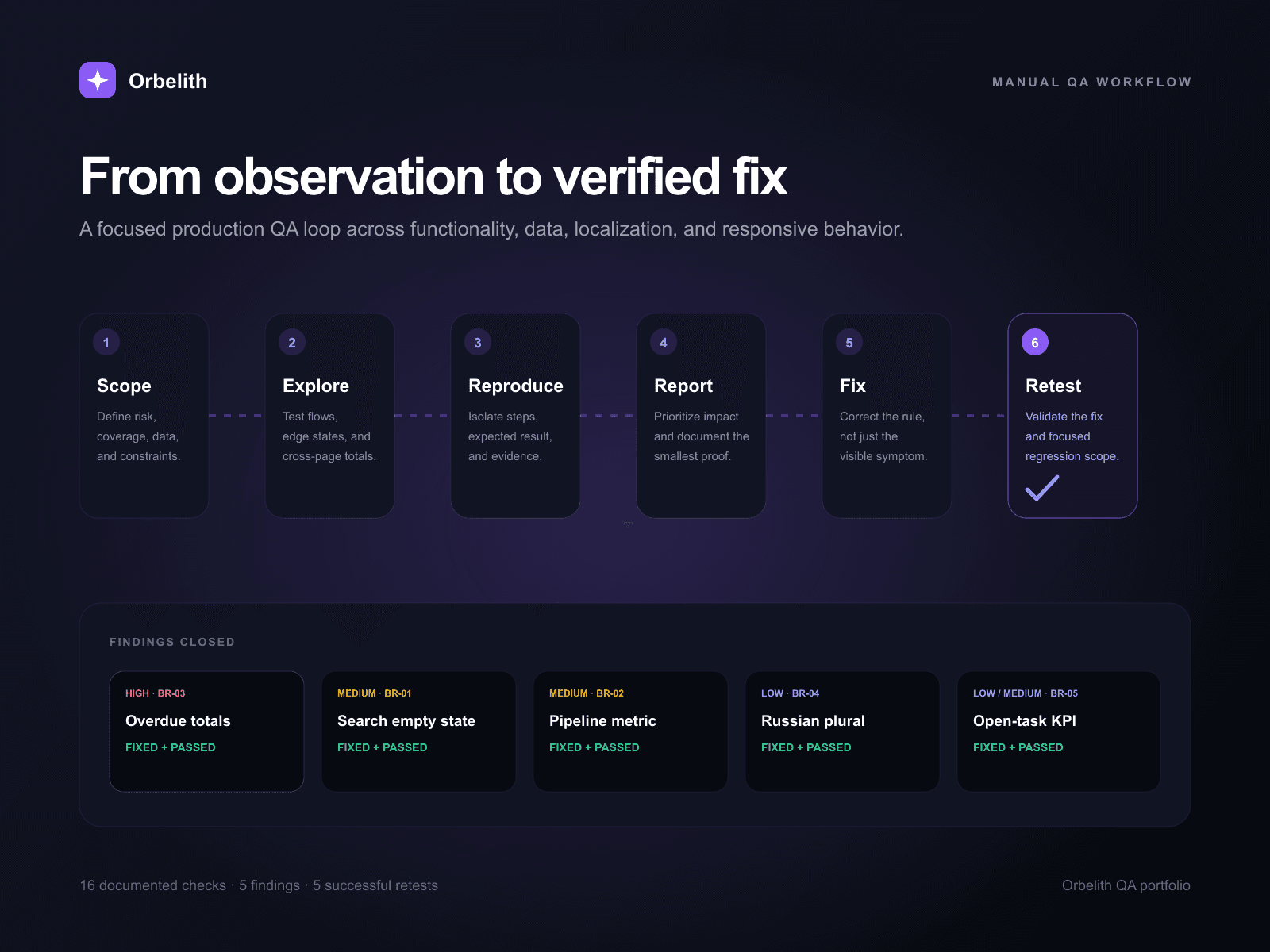
Each finding moved from observable behavior to reproducible evidence, impact-based severity, a product-level correction, and focused retesting.
10
Passed initially
5
Defects found
1
Environment block
0
Production records changed
Defect analysis
The defects ranged from misleading product feedback to a financial classification error that affected several dependent views.
Pending invoices past their due date were not consistently classified as overdue across finance surfaces.
Fixed · retest passed
Introduced one effective-status rule across Finance, Accounting, reports, client views, and scheduled digest logic.
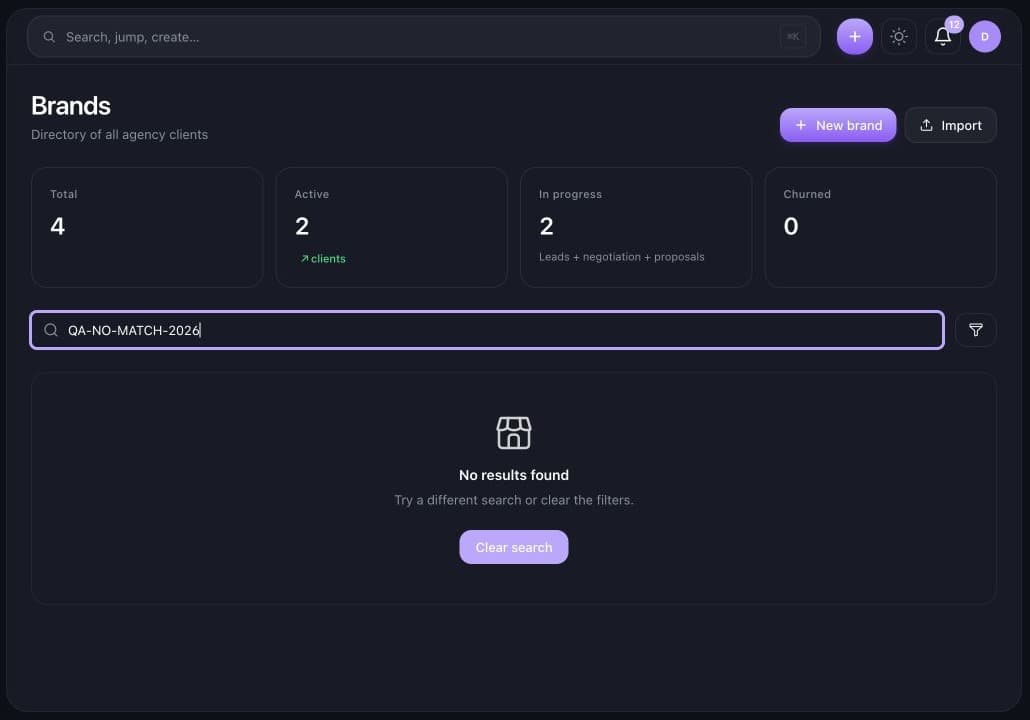
A no-match brand query displayed the first-use “no brands yet” state even though four brands existed.
Fixed · retest passed
Separated first-use and filtered no-result states and added a clear-search action.
The interface labeled current stage occupancy as conversion, which could lead to a false funnel interpretation.
Fixed · retest passed
Renamed the metric to current stage share and added explanatory context.
The singular state rendered “1 счетов” instead of the correct localized form.
Fixed · retest passed
Added locale-aware plural rules and checks for 1, 2, 5, 11, and 21.
The top-level KPI and the visible board used different counting scopes.
Fixed · retest passed
Aligned the KPI with the parent-task scope shown by the board and export.
Highest-impact finding
The overdue defect was not limited to one label. The correction had to propagate through Finance, Accounting, reports, brand details, the client portal, and scheduled digest logic.
BR-03 · High
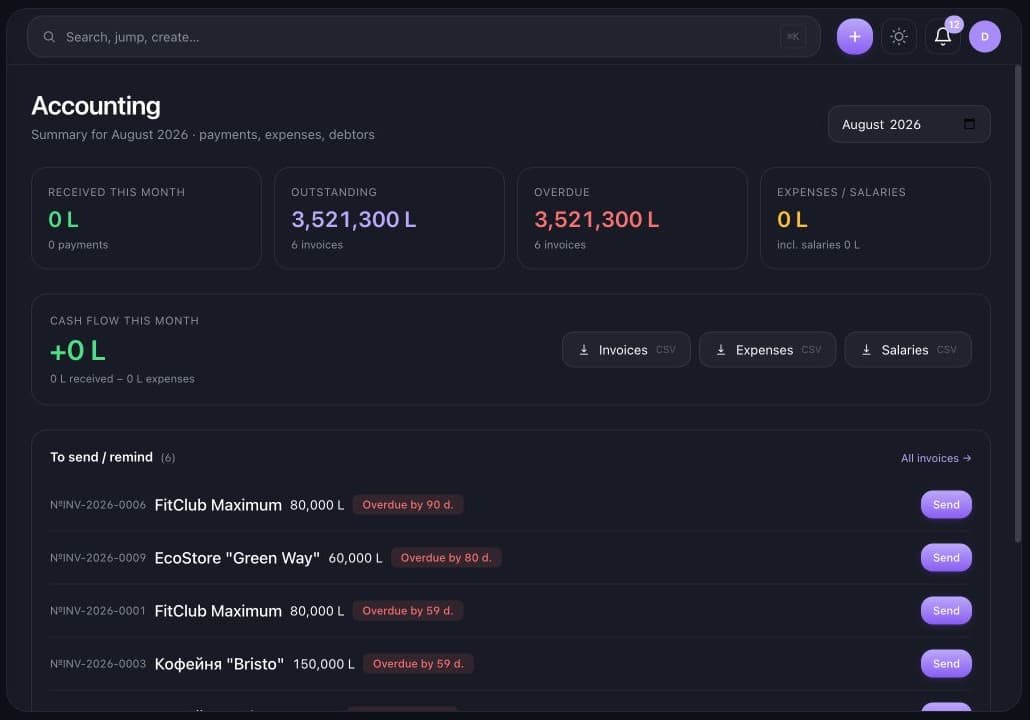
Production retest
The retest checked the visible outcome and the product rule behind it. Interface language is English; names inside demo records may remain multilingual.
BR-01 · Passed
Brands · filtered empty state
BR-02 · Passed
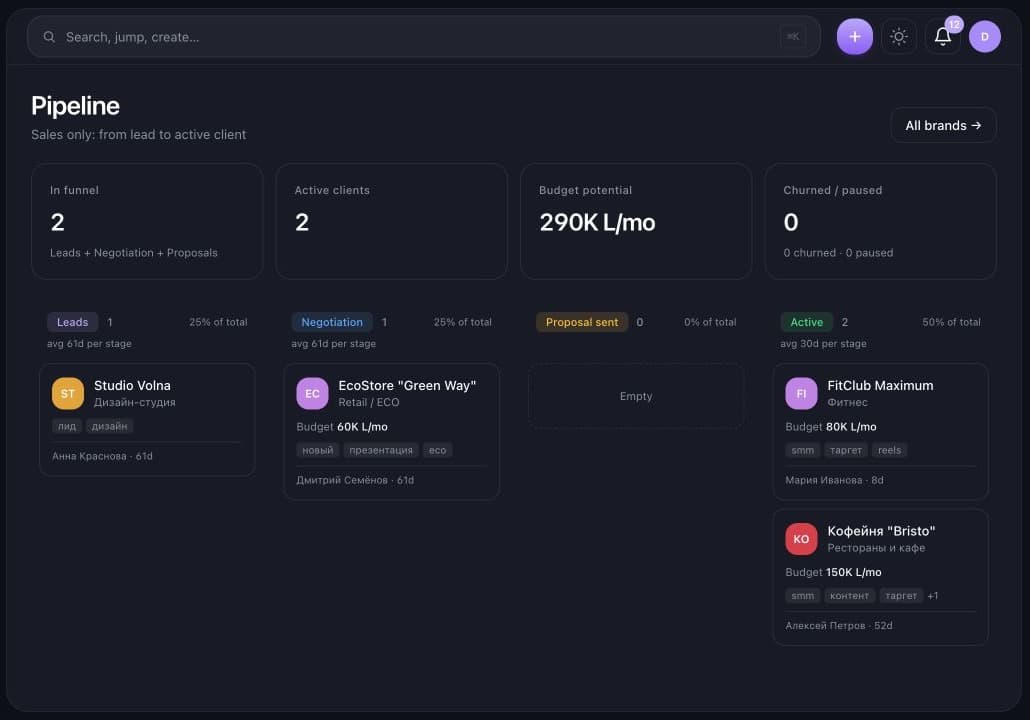
BR-05 · Passed
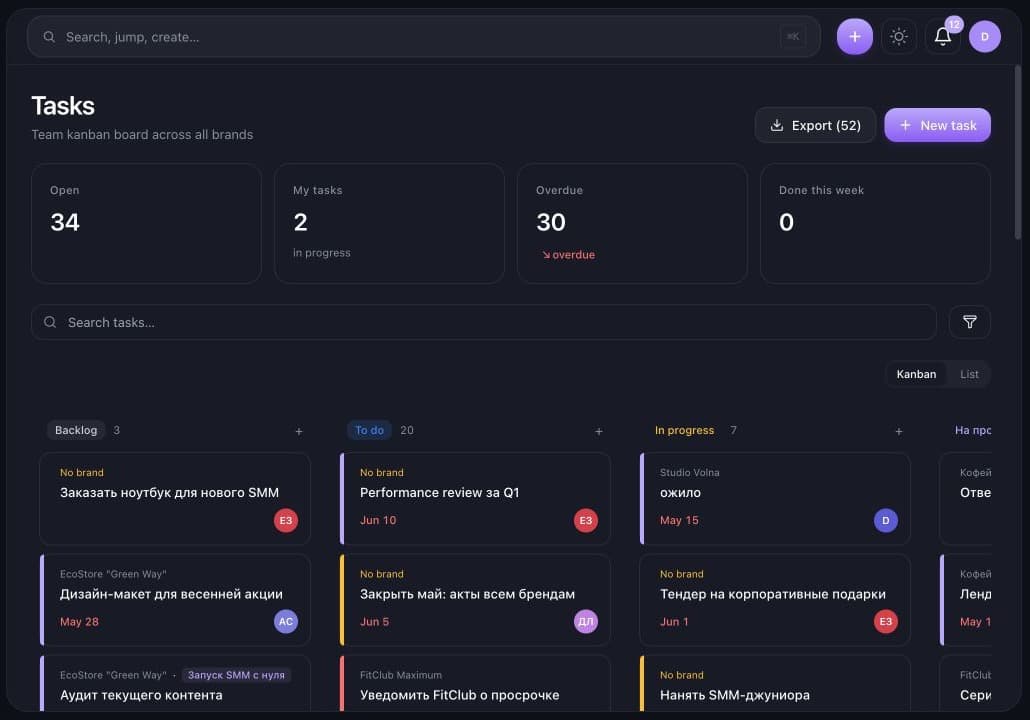
Security boundary
Existing Playwright request tests were used where a browser session was not required.
Outcome
The final result is a closed, traceable QA loop: defined coverage, reproducible findings, root-cause corrections, and production retest evidence.
All five documented product defects were fixed and passed focused production retesting.
One high-severity financial accuracy risk was corrected across every affected surface.
Search, pipeline, task, accounting, and localization behavior now use consistent product rules.
Responsive behavior passed at a 390 × 844 mobile viewport.
Request-level security checks passed for protected APIs and OAuth state handling.
No customer data was created, changed, deleted, or exported during the test pass.
Evidence note
This is a self-initiated case on the author-owned product. Screenshots were captured from the live owner workspace with demo records and personal account details excluded. The case does not use former-employer data or present reconstructed summaries as exported Jira artifacts.